Powered By Blogger

Saturday, May 3, 2014

A Material Object In Space

As a material object makes its flight through the air (molecules / medium), it is a substantially different thing from a sound wave traveling through air.  The principle of relativity holds the pair in a tension of physics contrariness.  A material object making a straight line flight at constant velocity through space (air / medium), is seen to have two different velocities, when viewed by two different observers, in two different frames. One frame is considered as being at rest, and the other frame is considered as being in motion with constant velocity.  Transfer of momentum and addition of velocities mask the velocity of the reference frame considered in motion, and the principle of relativity as a scientific concept prevents the detection of this motion.

The foundational propositions of Einstein’s Special Theory of Relativity (STR): the Lorentz transformation, time dilation, length contraction, etc., are based on a particular interpretation of the nature of the relationship between two inertial reference frames. Given two reference frames moving relatively to each other, the observer within the moving frame is considered at rest, though the reference frame is moving.  An observer in another reference frame that is at rest or stationary, views the motion of the first frame.  The observer in the first reference frame can not by any mechanical experiment detect his or her own reference frame’s motion.
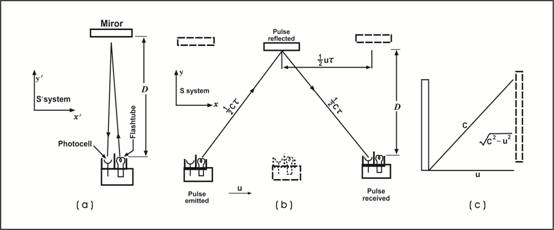
Two Reference Frames iin Relative Motion

By STR, though the train is in motion, it is regarded as being at rest in the reference frame attached to the train.  In the frame attached to the platform, the observer can clearly see the train’s motion.  Nonetheless, the observer on the train is assumed to be unable to do any mechanical experiment that can detect his or her motion.  The transfer of momentum of material objects cloaks any motions that might disclose any strange forces at work; through the addition of velocities, substantial speeds are kept hidden.  The property of waves (sound, EM, etc.), to not accept this transfer of momentum from its source, leads to the violation of Galilean invariance.  In other words, the wave speed remains fixed across reference frames, regardless of their relative velocity.

For example, a ball thrown rearward from the engine of the moving train has the velocity of the train subtracted from the ball’s velocity.  This maintains the appearance of the same distance of travel, and the same time for the journey; unbeknownst to the observer within the reference frame of the thrown ball. However, a sound wave directed rearward will not have any velocity subtracted, so that the wave will appear to travel a decreased distance, over a decreased duration of time, as the train moves forward.  This would hint at a possibly deeper reality.  For a material object, the influences of forces are somewhat hidden; for a sound wave they are not, they are just dodged and evaded.

In this thought experiment, I have shown that it is possible by the properties of sound waves, to lift this veil; to pull aside the curtain from the aforementioned proposition of the STR postulate.  That is, it is possible to pass through the wall between reference frames like a subatomic particle; to measure the same velocity value of a sound wave, by observers in separate reference frames that are moving with a constant velocity relative to one another.  It may become possible to overcome the static that jams any two-way communications between reference frames.

Saturday, March 29, 2014

A Flash of Light

I introduce a modification to my thought experiment; it will expand the use of the lantern as a light signal by the caboose observer. This modification will pull the platform observer into the midst of the experiment.

There is once again a train of length, L, moving at a constant velocity, v, along a level straight section of track on a windless day. Also, there is again an operator in the engine car and an observer in the caboose car. The platform observer will now take on a more significant role.

The air molecules, because it is a windless day, along with the platform and the Earth, are at rest relative to the moving train. There is a reference frame attached to the train and a reference frame attached to the Earth thus creating two coordinates systems moving relative to one another. Since the outside air / medium is disconnected from the motion of the train, the method outlined in this thought experiment makes it possible to calculate the velocity of the train. If the experiment were conducted within a single enclosed car, then the air molecules would follow the motion of the train and it would be impossible to find the velocity of the train by the method I have presented here.

The thought experiment begins with the caboose observer flashing her light signal to the engine car; at the same moment she begins her clock. The operator blows the train whistle at the moment he receives the light signal. Over this short distance the light signal is effectively instantaneous. She is prepared to measure the time, t, for the sound wave from the whistle to reach her.

When the she hears the sound wave travel the length of the train, from the engine to the caboose, she flashes her lantern once more, and stops her clock. Now this is where my modification enters the experiment. The platform observer also has a clock and he is able to see the flashes of light from the lantern. So, at the first flash he begins his clock, and at the second flash he stops his clock, thus also measuring the flight time, t, of the sound wave.

Now the physics question becomes, will both observers measure the same time, t? Since the two observers are moving at a constant rectilinear velocity relative to one another, by the principle of relativity they should find different velocities as viewed from the other’s reference frame. This applies to a material object flying through space, because they are in reference frames moving relative to each other. However, this does not apply to sound waves because of their violation of invariance, a concept known to science.

Her goal is, once again, to find the velocity of the train entirely from within the reference frame attached to the train. The principle of relativity says this not possible, but she imagines herself to be a clever science girl. She ponders upon the problem and imagines that a sound wave would be a solution to her problem; but may open a Pandora’s Box, of which she knows not the contents. Nonetheless, she proceeds.

She sets her equations as I have shown before. For the train moving forward, the caboose meets the rearward traveling sound wave within the distance L = ct - vt, with c representing the known speed of sound; the sound wave and the caboose start at the endpoints of L. If the train were to go in reverse, the sound wave from the whistle at the engine would have to overtake the rearward going caboose, so then, a similar type of formula would be applied: L - vt = ct. Both the sound wave and the caboose start at the endpoints of L, with each moving in the same direction. Each of the above formulas can be solved for the velocity of the train, v.

If her algebra is correct, what are the implications? She has found the velocity of the train, she thinks, but she is also aware that this seems to contradict the principle of relativity. The two observers have measured the same velocity for the train though each is in a reference frame moving relative to the other. The train length, L, is found from the technical specifications.The speed of sound, c, can be found in any science text.  Thus the platform observer and the caboose observer can use the same equation, L = ct - vt.  If they measure the same time, t, as implied by the formulas, then they will each find the same velocity, v, for the train.

The caboose and platform observer could also find the velocity, v, of the train by another means.  By noting the landmarks immediately opposite to the flashes, relative to the embankment, and by measuring the distance between the landmarks by some device, then v = d / t could be found.  But the landmark method cannot be extended to find a definition for simultaneity, or make use of Doppler to find a deeper interpretation of the motion of a material object through space.  Even more, only sound waves are a mechanical means that can be done from within the train’s reference frame to find v in as advantageous a way, as by sound waves.

A scenario that is similar, but not the same, is by throwing a lump of coal rearward (instead of a sound wave) from the steam engine with a strong arm. Neglecting air resistance and gravity, it should fly in a level and straight line. From this thrown material object or any other similar type of mechanical experiment, she cannot find the velocity of the train, while riding upon the train. But by a sound wave, she can perform an experiment that allows her to find the train’s velocity. She has uncovered another of reality’s many paradoxes.

If the platform observer threw a lump of coal, with the same arm strength as the train operator, to another person on the platform, then the platform observer would measure the same velocity (v = d / t) as the train observer for the velocity of the of lump of coal between the engine and caboose, though the train is moving and the platform is at rest. The outsider, by addition of velocities, measures a different velocity for the lump of coal, but he cannot communicate the illusion of the caboose observer’s measurement to her. He sees the lump of coal on the train travel a shorter distance and thus a shorter time (by Galilean transformation). But she is trapped in her illusions, with no mathematical way to clear the shadows of her blindness. She has no way to find the velocity of the train.

Until a sound wave is applied to the problem. That sound waves violate invariance is already well-known to physicists. Exploiting the phenomenon that sound waves do not gain any addition of velocity (vx = v'x - v0) from transfer of momentum, then this thought experiment makes it possible to measure the same velocity, distance, and time, across reference frames moving relative to each other. The seemingly paradoxical statements can both be true with a little cleverness. That the principle of relativity reflects reality and does not reflect reality seems an inescapable trap. The observers in two reference frames moving relative to one another can both measure different velocities for an object and the same velocity for that object, namely the velocity of the train.


An intermediary motion arises from betwixt the reference frames. It is different from the transfer of momentum imposed upon a material object by its initial cause of motion. Whether the object or reference frame is already in motion, or at rest, the law describing the object’s motion will be the same simple law (v = d / t), as viewed from within the reference frame. A sound wave leaps the hedge between reference frames; its velocity is not altered by the state of motion, or by the state of rest of the source. And by lifting the veil from this intermediary motion, she has found the velocity, v, of the train.

Sunday, February 16, 2014

Song from the Black Hole


I have recently learned about the concept that sound travels through Space.  At Harvard’s Chandra X-Ray Observatory they found that the collapse of a Black Hole causes sound waves that travel through interstellar space.  Empty space is not a pure vacuum; it has got stuff in it!

There is cosmic dust, high-energy particles and magnetic fields in the so-called vacuum of space; that can be detected as evidence of sound waves across thousands of light years of space by Earth instruments. This is evidence of violent space events, such as the collapse of Black Holes.  The frequency of the waves detected translate to a B-flat that registers well below the level of human hearing.  It’s more a single constant tone rather than a melodious song; but it is far more than the silence of a vacuum as we had formerly thought.

A sonic anemometer, or a Pitot tube for Lord Vader’s Death Star may be on the technological horizon.  If there is a medium, then my thought experiment becomes plausible.  For that matter, any device that is dependent on airflow measurements will become mechanically useful.

All objects that move through a medium, such as air or water, drags a thin layer of the medium along with it as it moves through the medium.  From a planet down to a golf ball, hydrostatic pressure causes this anti-aerodynamical layer of medium to stick to the surface of any object in flight.  But when the object is far away from any other large object the influence of this thin layer is minimized (such as two objects moving in tandem through space, but at some distance, L, apart).

On a day with no interstellar wind a starcruiser travels through the galaxy at some fraction of the speed of light (it is undoubtedly more than one Mach).  There are two devices attached to the outer shell of this one kilometer long spacecraft; at the front-end is a sound emitter and at the backend of the spacecraft is an ultra sensitive microphone.  Since the air above the thin hydrostatic pressure layer is disconnected from the spacecraft, then the formulas from my thought experiment can be used as a means of determining the velocity of the spacecraft anywhere in interstellar space.

Bcome a Black Hole Hunter, listen to the song  http://www.blackholehunter.org/

Thursday, December 5, 2013

Max Born

The principle of relativity as annunciated by Galileo, Newton, Einstein and many others states that:

♦ There is no mechanical experiment that can be done to detect absolute motion.

A form of this statement is the first postulate of the STR by Einstein. This principle can be rephrased in many formulations, which I will show are all violated by my proposed thought experiment (statement formulations are from Einstein’s Special Theory of Relativity by Max Born).

1.) The laws of mechanics have exactly the same expression as when referred to a coordinate system at rest in space.

2.) According to classical mechanics, the velocity of any motion has different values for two observers moving relative to each other.

3.) There are an infinite number of systems of reference moving uniformly and rectilinearly with respect to each other, in which all physical laws assume the simplest form (originally derived for absolute space or the stationary Aether).

4.) The laws of mechanics are invariant with respect to Galilean transformations.


♦ My caboose experiment is a mechanical experiment using sound waves passing through air molecules. It does not find the absolute motion but an intermediary motion that arises from somewhere between absolute motion and relative motion.

According to STR, L will always be , never allowing any indication of motion by ± vt. The only communication about any motion between reference frames is by the Lorentz and Galilean transformations; behind the Greek mask of time dilation and length contraction of units, a difference is seen from the perspective of the other reference frame.

1a.) The usual mechanics law that is presumed is the simple form v = [d / t], not t = L ± vt as I have shown by this experiment. And it is t = L ± vt in an infinity of other reference frames moving rectilinearly and uniformly relative to the initial reference frame, considered at rest.

2a.) Any and all observers, in motion and at rest, measure the same value for the velocity of the train. It is not a different value for different observers


3a.) There are an infinite number - at rest and in motion - but they do not assume the simplest form of physical laws in each frame. They take on the more complicated form I have shown above. That mimics the MM experiment.

4a) Physicists have long known that sound waves and light waves violate invariance, and I think I have found an experiment that utilize this scientific knowledge. That is, waves are a fount of mechanical information about Nature. Thus they each violate the principle of relativity, with considerable controversy attached. The Lorentz transformation is an overcoming approach for light waves; and my caboose thought experiment overcomes this invariance for with sound waves.

The violation of invariance results mostly from the consideration that the wave does not increase or decrease its velocity based on the velocity of the source or receiver; the motion of material objects do pick up a momentum from a force, which as a consequence, masks its true velocity across reference frames. In other words the wave does not pick up momentum from its source, so the wave might appear to go slower or faster; or the path length might seem to shorten or lengthen, depending upon the direction and magnitude of the source’s velocity.

For sound waves the wave crests grow closer together, or farther apart as the wave travels through the medium, but does not change velocity. For light waves, the STR proposes that alterations in space-time account for the differences arising from the point of view of separate observers in separate reference frames.

Both observers will say that the wave has the same single velocity in her and his own and the other’s references frame, either v = [L / t] - c, or, v = c - [L / t]; but a material object will have a different velocity as measured by each observer looking at the other‘s reference frame. In addition, each observer will use the same simple formula, v = [d / t], of motion for the same object within his or her own reference frame (moving or at rest), but use the velocity addition from the transformation equations in looking at the other’s reference frame. This, I think is the crux of invariance.


I think the use of sound waves in this thought experiment violate the principle of relativity and the first postulate of the Special Theory of Relativity. This experiment thus contradicts the assertions of the definitions of motion as expressed by Galileo, Newton, and Einstein.