Powered By Blogger

Sunday, February 16, 2014

Song from the Black Hole


I have recently learned about the concept that sound travels through Space.  At Harvard’s Chandra X-Ray Observatory they found that the collapse of a Black Hole causes sound waves that travel through interstellar space.  Empty space is not a pure vacuum; it has got stuff in it!

There is cosmic dust, high-energy particles and magnetic fields in the so-called vacuum of space; that can be detected as evidence of sound waves across thousands of light years of space by Earth instruments. This is evidence of violent space events, such as the collapse of Black Holes.  The frequency of the waves detected translate to a B-flat that registers well below the level of human hearing.  It’s more a single constant tone rather than a melodious song; but it is far more than the silence of a vacuum as we had formerly thought.

A sonic anemometer, or a Pitot tube for Lord Vader’s Death Star may be on the technological horizon.  If there is a medium, then my thought experiment becomes plausible.  For that matter, any device that is dependent on airflow measurements will become mechanically useful.

All objects that move through a medium, such as air or water, drags a thin layer of the medium along with it as it moves through the medium.  From a planet down to a golf ball, hydrostatic pressure causes this anti-aerodynamical layer of medium to stick to the surface of any object in flight.  But when the object is far away from any other large object the influence of this thin layer is minimized (such as two objects moving in tandem through space, but at some distance, L, apart).

On a day with no interstellar wind a starcruiser travels through the galaxy at some fraction of the speed of light (it is undoubtedly more than one Mach).  There are two devices attached to the outer shell of this one kilometer long spacecraft; at the front-end is a sound emitter and at the backend of the spacecraft is an ultra sensitive microphone.  Since the air above the thin hydrostatic pressure layer is disconnected from the spacecraft, then the formulas from my thought experiment can be used as a means of determining the velocity of the spacecraft anywhere in interstellar space.

Bcome a Black Hole Hunter, listen to the song  http://www.blackholehunter.org/

Thursday, December 5, 2013

Max Born

The principle of relativity as annunciated by Galileo, Newton, Einstein and many others states that:

♦ There is no mechanical experiment that can be done to detect absolute motion.

A form of this statement is the first postulate of the STR by Einstein. This principle can be rephrased in many formulations, which I will show are all violated by my proposed thought experiment (statement formulations are from Einstein’s Special Theory of Relativity by Max Born).

1.) The laws of mechanics have exactly the same expression as when referred to a coordinate system at rest in space.

2.) According to classical mechanics, the velocity of any motion has different values for two observers moving relative to each other.

3.) There are an infinite number of systems of reference moving uniformly and rectilinearly with respect to each other, in which all physical laws assume the simplest form (originally derived for absolute space or the stationary Aether).

4.) The laws of mechanics are invariant with respect to Galilean transformations.


♦ My caboose experiment is a mechanical experiment using sound waves passing through air molecules. It does not find the absolute motion but an intermediary motion that arises from somewhere between absolute motion and relative motion.

According to STR, L will always be , never allowing any indication of motion by ± vt. The only communication about any motion between reference frames is by the Lorentz and Galilean transformations; behind the Greek mask of time dilation and length contraction of units, a difference is seen from the perspective of the other reference frame.

1a.) The usual mechanics law that is presumed is the simple form v = [d / t], not t = L ± vt as I have shown by this experiment. And it is t = L ± vt in an infinity of other reference frames moving rectilinearly and uniformly relative to the initial reference frame, considered at rest.

2a.) Any and all observers, in motion and at rest, measure the same value for the velocity of the train. It is not a different value for different observers


3a.) There are an infinite number - at rest and in motion - but they do not assume the simplest form of physical laws in each frame. They take on the more complicated form I have shown above. That mimics the MM experiment.

4a) Physicists have long known that sound waves and light waves violate invariance, and I think I have found an experiment that utilize this scientific knowledge. That is, waves are a fount of mechanical information about Nature. Thus they each violate the principle of relativity, with considerable controversy attached. The Lorentz transformation is an overcoming approach for light waves; and my caboose thought experiment overcomes this invariance for with sound waves.

The violation of invariance results mostly from the consideration that the wave does not increase or decrease its velocity based on the velocity of the source or receiver; the motion of material objects do pick up a momentum from a force, which as a consequence, masks its true velocity across reference frames. In other words the wave does not pick up momentum from its source, so the wave might appear to go slower or faster; or the path length might seem to shorten or lengthen, depending upon the direction and magnitude of the source’s velocity.

For sound waves the wave crests grow closer together, or farther apart as the wave travels through the medium, but does not change velocity. For light waves, the STR proposes that alterations in space-time account for the differences arising from the point of view of separate observers in separate reference frames.

Both observers will say that the wave has the same single velocity in her and his own and the other’s references frame, either v = [L / t] - c, or, v = c - [L / t]; but a material object will have a different velocity as measured by each observer looking at the other‘s reference frame. In addition, each observer will use the same simple formula, v = [d / t], of motion for the same object within his or her own reference frame (moving or at rest), but use the velocity addition from the transformation equations in looking at the other’s reference frame. This, I think is the crux of invariance.


I think the use of sound waves in this thought experiment violate the principle of relativity and the first postulate of the Special Theory of Relativity. This experiment thus contradicts the assertions of the definitions of motion as expressed by Galileo, Newton, and Einstein.

Saturday, November 16, 2013

Caboose 3 : The Reversal - Meeting & Overtaking

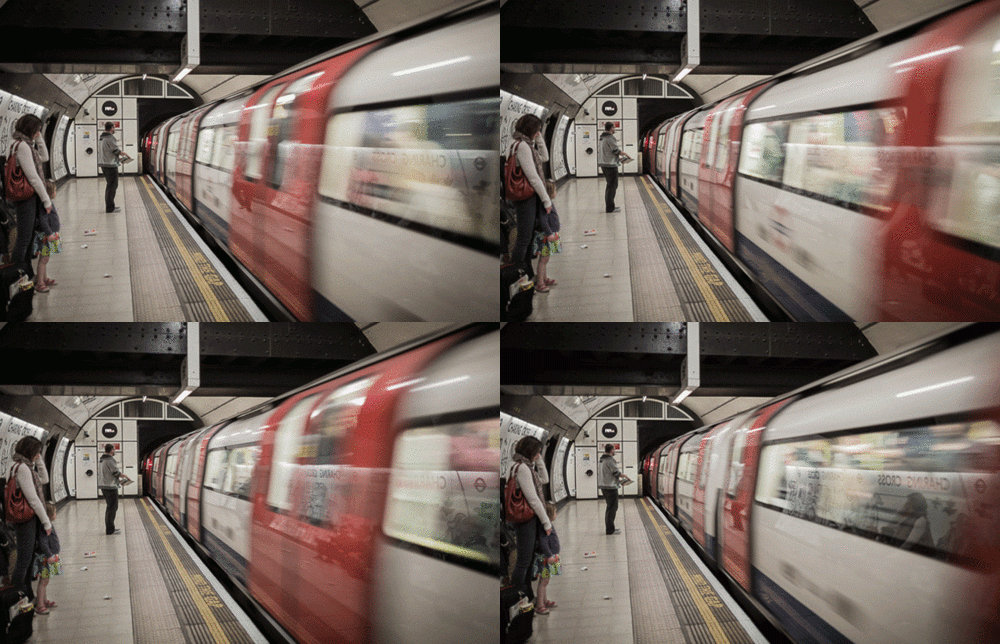
Stare into the image to reverse the train's motion!!!
If the train were to come to a complete stop, then begin to move in reverse for a few kilometers, at a new constant velocity, v, with the caboose leading and the engine following; then this would create a new situation and require a new formula. This new formula could be considered to represent the sound wave overtaking (or catching up to) the caboose; it is a windless day, the air molecules (medium) are at rest. This leads to the following formulas related to meeting and overtaking of the sound wave and the caboose:

♦ time = distance / velocity

 [L - vt2] / c = t2 (meeting)

♦ or

 [L + vt1] / c = t1 (overtaking)

With meeting or overtaking, the path length or distance, L, will increase or decrease due to the motion or velocity of the object in a certain direction and with a certain magnitude. In the forms as listed above, the motion of the train is going along with or is contrary to the motion of the sound wave. These formulas resemble the MM experimental equations for the reflection of a wave at hard surface:
♦ L / (c + v) = t2 (meeting)

♦ or

♦ L / (c - v) = t1 (overtaking)

As I have shown before the observer on the train uses the following formula to find the train velocity: L = ct2 + vt2 (meeting), or, L = ct1 - vt1 (overtaking). However, the observer at relative rest in the rest area will also use the same formulas. This emerges as a result of the idea that the displacement along the x-axis in a reference frame (whether the reference frame is regarded as in motion or at rest), may be represented by x2 - x1 = L.

In a reference frame moving with constant velocity relative to the resting frame, by the Galilean transformation this displacement is represented by (x2 + vt) - (x1 + vt) = x2 - x1 = L. Thus the formula L = ct2 + vt, or L = ct1 - vt1 applies to the motion of the train from the viewpoint of each reference frame. Each reference frame measures the identical time on a clock, and each observer (one at rest, and one in motion) has a means to find the velocity of the train, v, by the same formula (L = ct ± vt), which is not the simplest form of the law or equation of motion (v = [d /t]).


Saturday, November 2, 2013

Jupiter's Delays

The mathematical value of the speed of light, c was first discovered as being very large, but finite, by Danish astronomer Olaf Roemer in 1676. During his astronomical observations of Jupiter and the eclipses of its many moons, he calculated the speed of light to a very close approximation. The light covered across the vast distance to the Earth, L, as the moon ventured in and out of Jupiter‘s shadow, at various points of the yearly seasons as both planets orbited the Sun. He was able to compare the times, t, from several observations of Jupiter’s eclipses to arrive at c.

In 1879, Scottish physicist James Clerk Maxwell proposed, in a letter to American astronomer David Peck Todd, to extend Roemer’s experiments to find the speed, v, of the Earth-Jupiter tandem as the Solar System celestially circumnavigated through the Aether of deep space. At certain times of its yearly orbit, the Earth is in a very advantageous position to observe the moons, such as Io, of Jupiter pass through its shadow, created by the Sun. When Io emerges from this shadow, or eclipse, this event is observable on the Earth.

If the E-J tandem were at rest in space/Aether, then the light would experience a delay of t = L / c over and above the time for Io to make a single orbit of Jupiter, from shadow to shadow. This is the difference as determined by comparing the orbit times between two or more eclipses. At various points of the year this delay, L / c, is longer or shorter, because, as speculated by Roemer, the distance, L, between Earth and Jupiter is changing. By some mathematical acrobatics, Roemer was able to isolate c, and solve for its value.

So Maxwell speculated that there was an unaccounted component due to the Solar System’s (with the Earth and Jupiter in it) velocity through interstellar space. To find this velocity, v, became his goal. By making his astronomical observations when Jupiter takes their least amount of time (shortest, L, or L - vt2) between eclipses of Io, and then waiting until the eclipses take their greatest time (longest, L, or L + vt1) for an orbit, then Maxwell concluded that he could introduce the velocity, of the Solar System.


Posted Image


These two formed a tandem in which their distance apart, L, was aligned with the hypothetical motion of the SS through space. From this, Maxwell thought that based on astronomical observations at these opposite extremes, the delays would be different. The light is traveling alternately, with and against the motion of the SS. Then he supposed that he could introduce L / (c + v) and L / (c - v); then add these values (I have chosen to add rather than subtract, [2Lc] / [c² - v²], from Michelson-Morley) to solve for the velocity of the SS (and E-J tandem), v.
According to Einstein’s STR the delay due to the motion of the planets vanishes in the warping of space-time formulas. But astronomical observations have not made a statement confirming or denying the existence of this small delay which could be due to the velocity of the Solar System.

http://en.wikipedia..../wiki/Ole_Rømer
http://ether.wikiext...Maxwell_1879_en