Powered By Blogger

Saturday, November 16, 2013

Caboose 3 : The Reversal - Meeting & Overtaking

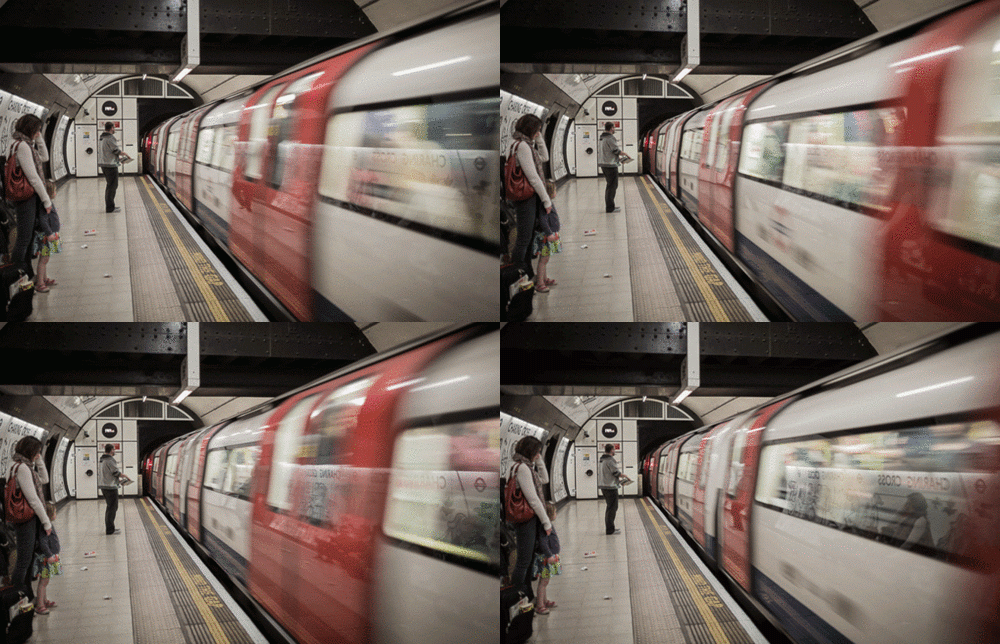
Stare into the image to reverse the train's motion!!!
If the train were to come to a complete stop, then begin to move in reverse for a few kilometers, at a new constant velocity, v, with the caboose leading and the engine following; then this would create a new situation and require a new formula. This new formula could be considered to represent the sound wave overtaking (or catching up to) the caboose; it is a windless day, the air molecules (medium) are at rest. This leads to the following formulas related to meeting and overtaking of the sound wave and the caboose:

♦ time = distance / velocity

 [L - vt2] / c = t2 (meeting)

♦ or

 [L + vt1] / c = t1 (overtaking)

With meeting or overtaking, the path length or distance, L, will increase or decrease due to the motion or velocity of the object in a certain direction and with a certain magnitude. In the forms as listed above, the motion of the train is going along with or is contrary to the motion of the sound wave. These formulas resemble the MM experimental equations for the reflection of a wave at hard surface:
♦ L / (c + v) = t2 (meeting)

♦ or

♦ L / (c - v) = t1 (overtaking)

As I have shown before the observer on the train uses the following formula to find the train velocity: L = ct2 + vt2 (meeting), or, L = ct1 - vt1 (overtaking). However, the observer at relative rest in the rest area will also use the same formulas. This emerges as a result of the idea that the displacement along the x-axis in a reference frame (whether the reference frame is regarded as in motion or at rest), may be represented by x2 - x1 = L.

In a reference frame moving with constant velocity relative to the resting frame, by the Galilean transformation this displacement is represented by (x2 + vt) - (x1 + vt) = x2 - x1 = L. Thus the formula L = ct2 + vt, or L = ct1 - vt1 applies to the motion of the train from the viewpoint of each reference frame. Each reference frame measures the identical time on a clock, and each observer (one at rest, and one in motion) has a means to find the velocity of the train, v, by the same formula (L = ct ± vt), which is not the simplest form of the law or equation of motion (v = [d /t]).


Saturday, November 2, 2013

Jupiter's Delays

The mathematical value of the speed of light, c was first discovered as being very large, but finite, by Danish astronomer Olaf Roemer in 1676. During his astronomical observations of Jupiter and the eclipses of its many moons, he calculated the speed of light to a very close approximation. The light covered across the vast distance to the Earth, L, as the moon ventured in and out of Jupiter‘s shadow, at various points of the yearly seasons as both planets orbited the Sun. He was able to compare the times, t, from several observations of Jupiter’s eclipses to arrive at c.

In 1879, Scottish physicist James Clerk Maxwell proposed, in a letter to American astronomer David Peck Todd, to extend Roemer’s experiments to find the speed, v, of the Earth-Jupiter tandem as the Solar System celestially circumnavigated through the Aether of deep space. At certain times of its yearly orbit, the Earth is in a very advantageous position to observe the moons, such as Io, of Jupiter pass through its shadow, created by the Sun. When Io emerges from this shadow, or eclipse, this event is observable on the Earth.

If the E-J tandem were at rest in space/Aether, then the light would experience a delay of t = L / c over and above the time for Io to make a single orbit of Jupiter, from shadow to shadow. This is the difference as determined by comparing the orbit times between two or more eclipses. At various points of the year this delay, L / c, is longer or shorter, because, as speculated by Roemer, the distance, L, between Earth and Jupiter is changing. By some mathematical acrobatics, Roemer was able to isolate c, and solve for its value.

So Maxwell speculated that there was an unaccounted component due to the Solar System’s (with the Earth and Jupiter in it) velocity through interstellar space. To find this velocity, v, became his goal. By making his astronomical observations when Jupiter takes their least amount of time (shortest, L, or L - vt2) between eclipses of Io, and then waiting until the eclipses take their greatest time (longest, L, or L + vt1) for an orbit, then Maxwell concluded that he could introduce the velocity, of the Solar System.


Posted Image


These two formed a tandem in which their distance apart, L, was aligned with the hypothetical motion of the SS through space. From this, Maxwell thought that based on astronomical observations at these opposite extremes, the delays would be different. The light is traveling alternately, with and against the motion of the SS. Then he supposed that he could introduce L / (c + v) and L / (c - v); then add these values (I have chosen to add rather than subtract, [2Lc] / [c² - v²], from Michelson-Morley) to solve for the velocity of the SS (and E-J tandem), v.
According to Einstein’s STR the delay due to the motion of the planets vanishes in the warping of space-time formulas. But astronomical observations have not made a statement confirming or denying the existence of this small delay which could be due to the velocity of the Solar System.

http://en.wikipedia..../wiki/Ole_Rømer
http://ether.wikiext...Maxwell_1879_en 

    Friday, October 18, 2013

    Caboose 2: The Solution

    The principle of relativity as annunciated by Galileo, Newton, Einstein, and others, states that no mechanical experiment can be done in an enclosed room that could detect the absolute motion of the room. There may not be anything such as absolute motion, only statements of relative motion expressed by mathematical formulas; but I hypothesize that the following thought experiment outlines a way of defining an intermediary motion that arises from some Aether, that resides between absolute motion and relative motion. This is in contradiction to any form of Relativity that has been expressed by modern science.

    Suppose a long train with several cars, a caboose, and a locomotive engine, travels down a long level section of track at a constant velocity, v.  There is an observer in the caboose and an engineer in the locomotive car. It is a windless day (still air, motionless medium).  This observer might ask: can I find the speed of the train relative to the air, or another observer at rest on a nearby platform (both at rest relative to train)?


    She has a light source (a lantern, maybe) to send a signal to the locomotive car and engineer. This light signal is effectively instantaneous over this short distance.  He blows the whistle when he receives the signal (disregarding reaction time).  If she starts her clock when she sends the light signal, then she can measure the time, t, for her to hear the returning sound signal (speed of sound, c; c is a symbol for sound and light, and represents a constant, no addition of velocities).

    Thus, during the same time that the train is in forward motion, the whistle sound wave is in rearward motion. She speculates that she will meet the sound pulse somewhere within the distance, D, from the engine to the caboose.  By algebra, with the opposite endpoints of D as the starting places of the caboose’s motion, and the sound wave’s motion:

    D = ct + vt   (t = t)
    v = [D / t] - c      

    Is she correct in thinking that she can find the velocity, v, of the train based on this total time, t; which she measures on her single clock?  She imagines that this thought experiment assails the wall of separation between reference frames; between the reference frame attached to the moving train, and the other reference frame attached to the platform which is considered at rest.  She has found a method for determining her speed relative to the earth; based only on information available from within the reference frame attached the train.  She is furthermore sharing in the motion of train (she is at rest relative to the train).

    The Newtonian laws of motion do not take their simplest form in either reference frame. Instead, each takes on a form related to the Galilean transformation equations (similar to the Michelson-Morley formulas: L = ct + vt; t = L / [c + v]).  That is, in both the moving frame, and the frame at rest, the distance, L, between the two starting points stays the same.  Despite the Galilean transformation, the distance, L, will be preserved across reference frames L = (x2 - vt) - (x1 - vt) = x2 - x1 = L; the vt‘s have cancelled out).  The observer at rest in the rest area will note that the caboose is in motion, as well as that the sound wave is in motion.  But the times measured in each reference frame will be the same, thus allowing the observer on the caboose to solve for v, the velocity of the train.  This contradicts the principle of relativity once again.


    Friday, September 20, 2013

    LIGO not LEGO: Sound & Light

    http://en.wikipedia.org/wiki/LIGO

    The artifice underlying Einstein’s STR is the mathematical construct that the two reference frames are represented by different equations, or laws of motion; but from within a reference frame an observer cannot distinguish whether he or she is in motion or at rest, based on mathematical observations from within the reference frame.  An outside observer can make the distinction.

    For sound waves, my thought experiment shows that these formulas are the same and are not the simplest form of the laws of motion.  The unassailable wall between reference frames has been breeched by my pace car experiment.  For light waves, it may be just a matter of time for this light wave from beneath its black pall; that a reference frame may regarded as at rest, when in actuality it is in motion.  But mathematical laws for bodies at rest were indistinguishable from bodies in motion  by the principles of relativity, and the construct of reference frames.  Now this dreamstate has been intruded upon by the presentation of my thought experiment.

    For a sound source in motion, my thought experiment  shows the breakdown of the artifice of the principles of relativity.  The equation of motion laws have been  assailed. They no longer take their simplest form in either reference frame; neither the one regarded as at rest, nor the one regarded as in motion.  However, or a light source in motion, the artifice stands impregnable.  The Null Result of the MM experiment provides a sturdy defense.  The motion of the light source is cloaked in invisibility, hiding behind the bending of the space-time continuum; whatever that may be, mathematics or reality, mathematics is not reality.  Thus for light, can this wall of separation ever be scaled? I do not know.

    In Livingston, Louisiana and Hanford, Washington, USA the Laser Interferometer Gravitational-Wave Observatory (LIGO) conducts experiments to detect gravitational waves; these waves were predicted by Einstein in his General Theory of Relativity.  They have not detected any as yet.  So I have come up with an alternative use of the facilities while they are waiting to catch a Gravitational Wave.

    The facility is a multi-kilometer sized Michelson-Morley interferometer intended to measure interference from two light beams reflected by mirrors along two long enclosed arms, or corridors, perpendicular to each other.  My thought experiment will require only the single arm parallel to the earth‘s motion in its orbital path around the sun.

    Instead of a light emitter at the intersection of the two arms, there is a sound cannon at this axis or origin point.  At the end of this arm is a sound sensor that activates a light emitter.  Since the air molecules are pretty much motionless in this enclosed corridor, they will follow the course of the motion of the corridor.  This is a consideration that will have an effect on the form of the law of motion of the sound pulse through the still air.  The air and corridor are motionless relative to each other in the reference frame attached to the earth.

    Thus the sound cannon and the sound sensor/light emitter configuration form a tandem that are at rest relative to one another but are on the earth as it hurtles through the Cosmos at the velocity, v; a velocity, a motion, as seen by an observer at rest not on the Earth.  Essentially the roles of the light and sound have been reversed in this thought experiment.  The light receiver and a clock are moving towards the light source, creating a scenario that is similar to the pace car thought experiment.

    The sound source and the light source are moving in tandem relative to Space (Aether?).  Since the experiment takes place in a closed corridor, sound will adhere to the principle of relativity as regards the air molecules;  but light has only Einstein’s accounting for this scenario of motion, since he accepts that light waves can travel where there is no medium.

    This leads to a very similar scenario that involves sound waves (which violate Galilean invariance), which could be solved with a simple mechanical application.  Whereas, light solves the situation by means of the complicated application of the STR (Lorentz transformation, length contraction, and time dilation, etc.) involving the alteration of space.

    As compared with sound, light, in the STR, does not adhere to this violation the same way.  With no mathematical or scientific justification, other than that the equations work.  All that is solid melts into air, as space and/or the Aether remain unexplained mysteries.

    So if a similar scenario to the sound configuration/pace car is set up for light, the time for light to make its return flight will be according to Einstein t = L / c. It is only my speculation that a precise clock could be made to measure a time minutely different from t = L / c, such as t = L / (v + c).  But Einstein says this difference is impossible to access. By some transmutation of space, or the Aether, due to the velocity of the object, it cannot be measured.  His definition of Space and Reality does not allow it. because his definition of reality imagines it is not there.

    A precise enough clock already exists that could measure this time difference over this long distance, between the earth in motion (velocity) to that of the earth at rest. Maybe this thought experiment would be successful.  But the null result of the MM experiment to detect the Aether wind,  and STR time dilation and length contraction denies the possibility of detecting this time difference.  The time will follow the usual law of Newton and thus be different in two reference frames moving with a constant velocity relative to each.  The Lorentz transformation and time dilation are to account for this conceptual difference.

    If she starts her precise clock at the moment that she fires the sound cannon then the time for the sound pulse to travel L, is t = L / c (because the air molecules though motionless within the sealed corridor, they are moving at the same velocity of the earth).  The time for the returning light pulse , would be however, according to classical mechanics, L / (c + v) which would account for the forward motion of the earth and light receiver (through the Aether wind of MM) meeting the light pulse traveling in the opposite direction, by algebra..

    If the earth were at rest, then the total time for this experiment would be T = [L/c] + [L/c]  combining the time for the sound to travel down the corridor, and the time for light to travel back along the corridor. And thus this is the total time put forward by the principle of relativity and STR.

    For a wave (sound or light) violating Galilean invariance this is L / (c + v).  If a train of the same length as the LIGO observatory were traveling across the flat featureless landscape, then the sound waves traveling back towards the caboose would travel a shorter distance than L because of the train’s forward motion. On a windless day, this is because the motion of the train is disconnected from the stationary air (medium).  But in the long narrow laboratory of LIGO, there is no medium for the light to interact with, that can even remotely unmask or explain the Earth’s motion.  So, we are left only with mysteries, shadows, and suspicions.

    According to classic mechanics, and the MM experiment, the total time would be T = [L/c] + [L/(c+v)]   This is a small but measurable difference according to the construction of my thought experiment.   But according to STR, time dilation and length contraction this difference vanishes.  What should arise from the motion of the earth, disappears into space-time.  Einstein’s STR attributes and conforms the difference in times due to an alteration in the fabric of space; not an alteration directly linked to, or coming out of the Earth’s velocity.

    Currently there is research being done in the area of Quantum Theories which predicts that at the subatomic level, there is a violation of Lorentz invariance by electromagnetic waves.  This may provide fertile ground for the possibility of conducting some form of this thought experiment.